ICAC’s new Integrity Assurance Standards for Computer System garners full support from B/Ds and demonstrates Government’s determination to strengthen integrity governance through digital technology
2026-9-2
The ICAC today (September 2), in partnership with the Innovation, Technology and Industry Bureau (ITIB) as well as the Digital Policy Office (DPO), launched the “Integrity Assurance Standards for Computer System” (the Standards), tailored for assisting all Government bureaux and departments (B/Ds) to enhance corruption prevention capabilities and strengthen integrity governance by using digital technology.
The ICAC held a launching ceremony for the Standards this morning, officiated by ICAC Commissioner Mr Woo Ying-ming, Acting Secretary for Innovation, Technology and Industry, Ms Lillian Cheong Man-lei, Acting Commissioner for Digital Policy, Mr Daniel Cheung Yee-wai and Head of the Department of Sociology of the University of Hong Kong, Professor Tarani Chandola. Mr Woo highlighted that in response to the system vulnerabilities identified during past corruption investigations in the public sector and anti-corruption reviews conducted for B/Ds, the ICAC has developed the Standards to introduce core control measures in computer systems to enhance integrity assurance. This corruption prevention initiative had, for the first time, achieved unprecedented support and responses from the majority of the B/Ds. This not only showcased the Government’s determination to enhance integrity assurance in computer systems, but also provided a new driving force for the future era of integrity governance.
“Vulnerabilities in Government computer systems will increase both corruption and compliance risks, which will erode Government credibility and affect public interest. Both public and private bodies worldwide are exploring ways to use technology in preventing and detecting corrupt practices. Integrating anti-corruption elements into computer systems will become a major trend in the future,” Mr Woo noted. He also hoped that the Standards could help B/Ds enhance system integrity assurance, prevent and detect suspected cases, and minimise corruption risks.
Mr Woo noted that in accordance with the new arrangement introduced by the DPO starting from July this year, upon applying for relevant funding for computer systems, B/Ds should assess whether the system has met the Standards to include appropriate control measures. The ICAC would provide assistance throughout the process.
Ms Cheong remarked that the Standards adopt a “prevention is better than cure” mindset, which is instrumental in driving the high-quality development of a digital Government. “Innovation and technology as well as integrity governance complement each other. Integrating integrity control measures into computer systems ensures that technology is applied in a more secure and reliable manner, thereby earning greater public trust. The ITIB and the DPO will continue to work closely with the ICAC to promote and apply the Standards. By embedding integrity governance into more innovation and technology initiatives, we aim to build a healthier and more resilient digital Government and technology ecosystem in Hong Kong,” Ms Cheong noted.
The event was attended by around 120 directorate officers and IT supervisors from more than 60 B/Ds. Subsequent to the launching ceremony, the Hong Kong International Academy Against Corruption also organised a thematic seminar for the B/Ds. ICAC officers shared case scenarios where digital measures were introduced to improve workflows and plug corruption loopholes. Representatives from the Environmental Protection Department and the Census and Statistics Department also shared their respective research and development (R&D) solutions in artificial intelligence and data science, which effectively met the Standards’ principles and requirements.
The ICAC also invited representatives from the Hong Kong Applied Science and Technology Research Institute to demonstrate their R&D solutions in facilitating integrity controls. Tencent Group also participated as an industry representative from the innovation and technology sector, showcasing its successful experience in using digital technologies for internal control.
The Standards set out 12 specific control measures, relevant corruption risks and corruption prevention advice, including the introduction of user authentication to prevent unauthorised access to confidential information, audit trail logging and anomaly alerts. They integrate integrity controls into IT systems from three perspectives comprising system security, workflow control and anomaly detection. The DPO and the Department of Sociology of the University of Hong Kong rendered professional advice during the development of the Standards to ensure it was pragmatic and practical.
The ICAC held a launching ceremony for the Standards this morning, officiated by ICAC Commissioner Mr Woo Ying-ming, Acting Secretary for Innovation, Technology and Industry, Ms Lillian Cheong Man-lei, Acting Commissioner for Digital Policy, Mr Daniel Cheung Yee-wai and Head of the Department of Sociology of the University of Hong Kong, Professor Tarani Chandola. Mr Woo highlighted that in response to the system vulnerabilities identified during past corruption investigations in the public sector and anti-corruption reviews conducted for B/Ds, the ICAC has developed the Standards to introduce core control measures in computer systems to enhance integrity assurance. This corruption prevention initiative had, for the first time, achieved unprecedented support and responses from the majority of the B/Ds. This not only showcased the Government’s determination to enhance integrity assurance in computer systems, but also provided a new driving force for the future era of integrity governance.
“Vulnerabilities in Government computer systems will increase both corruption and compliance risks, which will erode Government credibility and affect public interest. Both public and private bodies worldwide are exploring ways to use technology in preventing and detecting corrupt practices. Integrating anti-corruption elements into computer systems will become a major trend in the future,” Mr Woo noted. He also hoped that the Standards could help B/Ds enhance system integrity assurance, prevent and detect suspected cases, and minimise corruption risks.
Mr Woo noted that in accordance with the new arrangement introduced by the DPO starting from July this year, upon applying for relevant funding for computer systems, B/Ds should assess whether the system has met the Standards to include appropriate control measures. The ICAC would provide assistance throughout the process.
Ms Cheong remarked that the Standards adopt a “prevention is better than cure” mindset, which is instrumental in driving the high-quality development of a digital Government. “Innovation and technology as well as integrity governance complement each other. Integrating integrity control measures into computer systems ensures that technology is applied in a more secure and reliable manner, thereby earning greater public trust. The ITIB and the DPO will continue to work closely with the ICAC to promote and apply the Standards. By embedding integrity governance into more innovation and technology initiatives, we aim to build a healthier and more resilient digital Government and technology ecosystem in Hong Kong,” Ms Cheong noted.
The event was attended by around 120 directorate officers and IT supervisors from more than 60 B/Ds. Subsequent to the launching ceremony, the Hong Kong International Academy Against Corruption also organised a thematic seminar for the B/Ds. ICAC officers shared case scenarios where digital measures were introduced to improve workflows and plug corruption loopholes. Representatives from the Environmental Protection Department and the Census and Statistics Department also shared their respective research and development (R&D) solutions in artificial intelligence and data science, which effectively met the Standards’ principles and requirements.
The ICAC also invited representatives from the Hong Kong Applied Science and Technology Research Institute to demonstrate their R&D solutions in facilitating integrity controls. Tencent Group also participated as an industry representative from the innovation and technology sector, showcasing its successful experience in using digital technologies for internal control.
The Standards set out 12 specific control measures, relevant corruption risks and corruption prevention advice, including the introduction of user authentication to prevent unauthorised access to confidential information, audit trail logging and anomaly alerts. They integrate integrity controls into IT systems from three perspectives comprising system security, workflow control and anomaly detection. The DPO and the Department of Sociology of the University of Hong Kong rendered professional advice during the development of the Standards to ensure it was pragmatic and practical.

ICAC Commissioner Mr Woo Ying-ming (second right), Acting Secretary for Innovation, Technology and Industry, Ms Lilian Cheong Man-lei (second left), Acting Commissioner for Digital Policy, Mr Daniel Cheung Yee-wai, (first left) and Head of the Department of Sociology of the University of Hong Kong, Professor Tarani Chandola (first right) officiate at the launching ceremony of the “Integrity Assurance Standards for Computer System”.

ICAC Commissioner Mr Woo Ying-ming highlights that the Standards are tailor-made for the computer systems of Government bureaux and departments, incorporating integrity and assurance.

ICAC Commissioner Mr Woo Ying-ming introduces the specific control measures in the Standards.

Acting Secretary for Innovation, Technology and Industry, Ms Lilian Cheong Man-lei acknowledges the importance of the Standards in driving high-quality development.
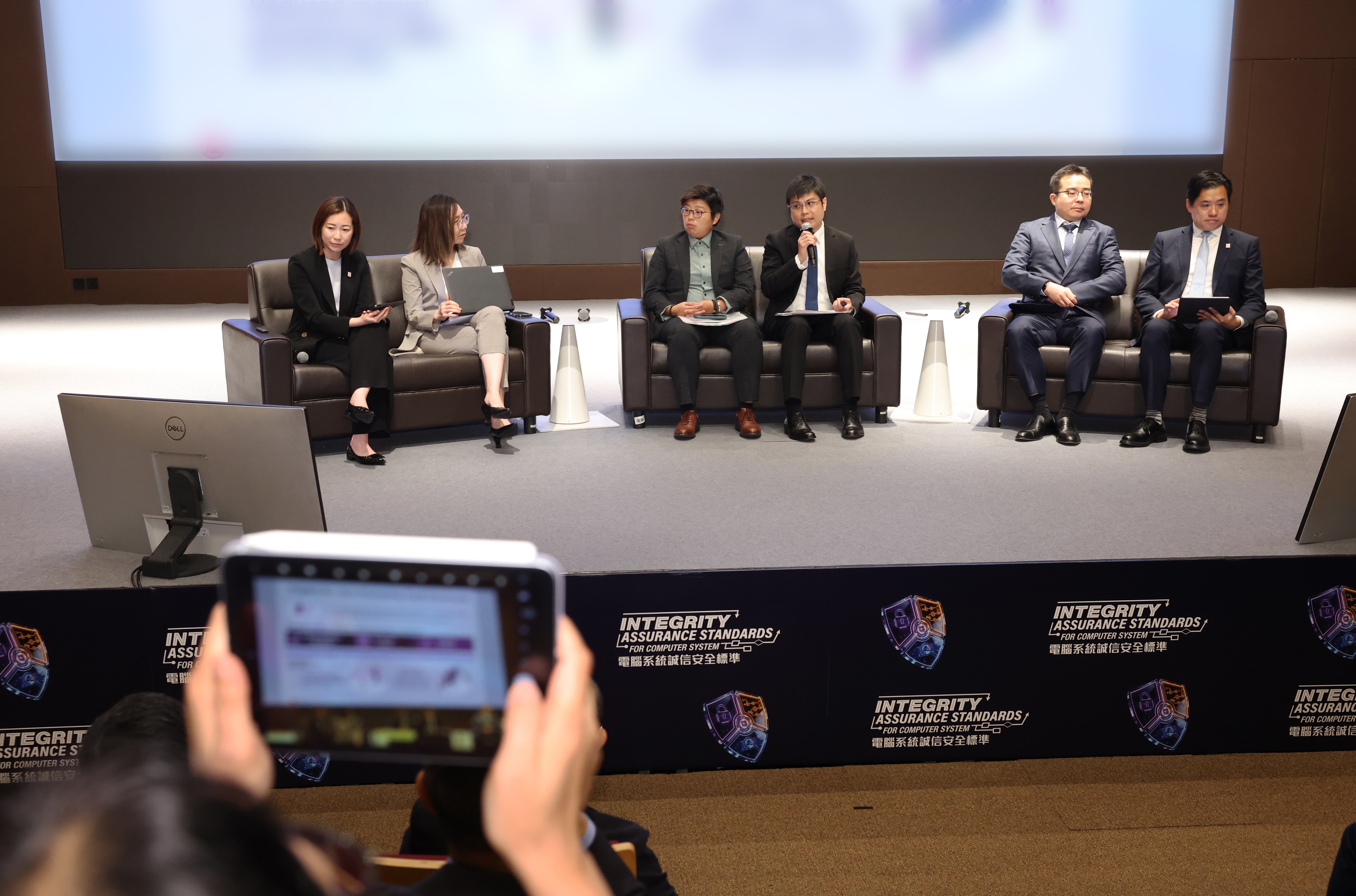
ICAC representatives exchange views and insights with the Principal Environmental Protection Officer (Corporate Affairs) of the Environmental Protection Department, Dr Jackie Ng, Senior Statistician (Data Science) of the Census and Statistics Department, Mr Hench Tang, Deputy Chief Technology Officer of the Hong Kong Applied Science and Technology Research Institute, Dr Tracy Liu, and Corporate Vice President and Head of Risk Management of Tencent Holdings Limited, Mr Danny Seto.
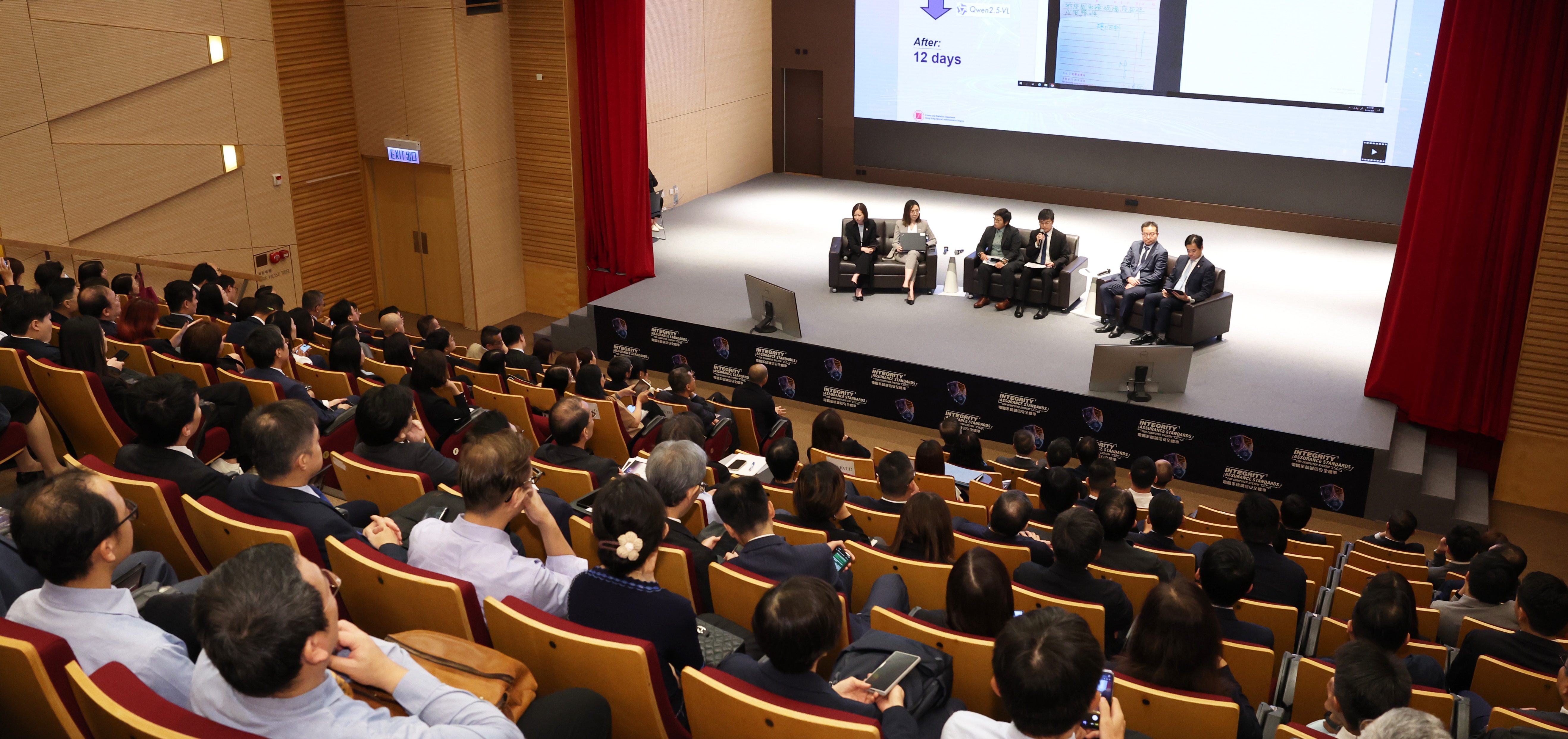
Around 120 directorate officers and IT supervisors from more than 60 B/Ds attend the launching ceremony of the Standards.