First ICAC capacity building training in HK signals closer ties on Belt and Road
2019-1-3
The ICAC today (January 3) plays host to 20 members of the Anti-Corruption Commission (ACC) of Bangladesh who are in Hong Kong to attend a customized capacity building training programme, the latest initiative of the local graft buster to foster international collaboration.
Speaking at the opening ceremony of the training programme, ICAC Commissioner Mr Simon Peh Yun-lu said international cooperation was instrumental to the successful fight against corruption.
“The training programme for the Bangladesh delegation is the first of its kind to be held in Hong Kong since the ICAC’s announcement last year to offer training assistance to other law enforcement agencies, including those along the Belt & Road (B&R) route,” Mr Peh said.
The 20 ACC members comprise anti-graft officers specially selected from 300 officers from ACC’s head office and 17 district offices across Bangladesh. They will attend a seven-day programme which covers over 20 modules on law enforcement, including interviewing complainants, witnesses and suspects; intelligence gathering, planning operations, arrests and searches; handling property and exhibits, forensic accounting, recovery of crime proceeds as well as giving evidence in court.
Participants will also visit various facilities of the Operations Department, including the Video Interview Room, Identification Parade Complex, Mock Court, Detention Centre and the Report Centre.
The customised programme was drawn up after a field study by ICAC officers who travelled to Bangladesh in April last year. In-depth discussions with senior management of the ACC were conducted to identify specific training needs.
“Despite the differences in our legal systems and law enforcement practices, this training programme can help reinforce the law enforcement capability of the ACC and further strengthen the mutual working relations between the two organisations,” Mr Peh said.
Mr Peh added that he hoped the ACC members, upon finishing the programme, would become multipliers by bringing home what they had learnt for the benefit of the ACC.
Under the United Nations Convention against Corruption, the ICAC has been designated by the Central People’s Government to assist States Parties, including those along the B&R route, in system and capacity building in the fight against corruption. Helping these countries to level their playing fields will also benefit Hong Kong companies and professionals who seek investments and development opportunities there.
So far, the Commission has commenced dialogues with over 30 anti-corruption agencies of B&R countries in relation to capacity building training. In October 2018, two ICAC delegations travelled to Cambodia and Myanmar respectively to conduct customised training programmes on law enforcement and community education for local graft-fighting agencies.
Speaking at the opening ceremony of the training programme, ICAC Commissioner Mr Simon Peh Yun-lu said international cooperation was instrumental to the successful fight against corruption.
“The training programme for the Bangladesh delegation is the first of its kind to be held in Hong Kong since the ICAC’s announcement last year to offer training assistance to other law enforcement agencies, including those along the Belt & Road (B&R) route,” Mr Peh said.
The 20 ACC members comprise anti-graft officers specially selected from 300 officers from ACC’s head office and 17 district offices across Bangladesh. They will attend a seven-day programme which covers over 20 modules on law enforcement, including interviewing complainants, witnesses and suspects; intelligence gathering, planning operations, arrests and searches; handling property and exhibits, forensic accounting, recovery of crime proceeds as well as giving evidence in court.
Participants will also visit various facilities of the Operations Department, including the Video Interview Room, Identification Parade Complex, Mock Court, Detention Centre and the Report Centre.
The customised programme was drawn up after a field study by ICAC officers who travelled to Bangladesh in April last year. In-depth discussions with senior management of the ACC were conducted to identify specific training needs.
“Despite the differences in our legal systems and law enforcement practices, this training programme can help reinforce the law enforcement capability of the ACC and further strengthen the mutual working relations between the two organisations,” Mr Peh said.
Mr Peh added that he hoped the ACC members, upon finishing the programme, would become multipliers by bringing home what they had learnt for the benefit of the ACC.
Under the United Nations Convention against Corruption, the ICAC has been designated by the Central People’s Government to assist States Parties, including those along the B&R route, in system and capacity building in the fight against corruption. Helping these countries to level their playing fields will also benefit Hong Kong companies and professionals who seek investments and development opportunities there.
So far, the Commission has commenced dialogues with over 30 anti-corruption agencies of B&R countries in relation to capacity building training. In October 2018, two ICAC delegations travelled to Cambodia and Myanmar respectively to conduct customised training programmes on law enforcement and community education for local graft-fighting agencies.

ICAC Commissioner Simon Peh (middle, front row), Consul General of The People's Republic of Bangladesh in Hong Kong Mehdi Hasan (3rd from left, front row) and ICAC officers pictured with 20 anti-corruption officers from Bangladesh.
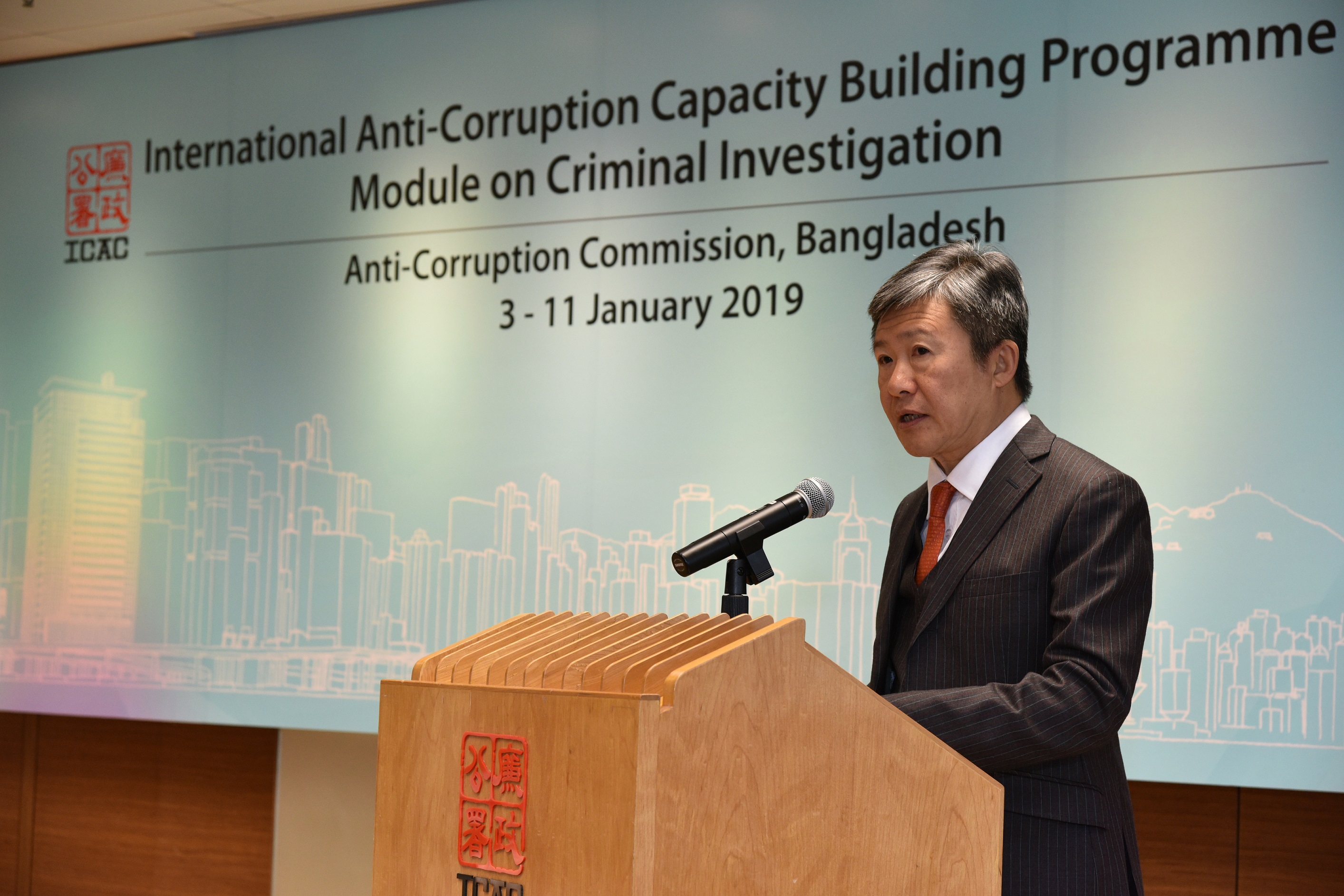
ICAC Commissioner Simon Peh addresses opening ceremony of the capacity building training course for the Bangladesh anti-graft officers.

ICAC officers shares the Commission’s latest anti-corruption initiatives to the participants.