Partnership to fight corruption grows stronger with expanded ICAC business ethics centre
2015-5-5
A strong partnership between the Independent Commission Against Corruption (ICAC) and the business sector in strengthening business ethics against corruption was the key to maintaining Hong Kong’s competitive edge and safe-guarding a level-playing field for businesses, said ICAC Commissioner Simon Peh Yun-lu.
Such a partnership was first institutionalised in 1995 when the ICAC allied with six major chambers of commerce in Hong Kong to establish the Hong Kong Ethics Development Centre (HKEDC) with a mandate to promote business ethics on a long term basis.
Mr Peh was addressing over 150 representatives from the consular corps, local and foreign chambers of commerce, international organisations, professional bodies, trade associations, regulatory authorities and ICAC advisory committees attending a reception to mark the 20th anniversary of HKEDC yesterday (May 4).
Drawing on its 20-year history, the Centre was rebranded Hong Kong Business Ethics Development Centre (HKBEDC) to better reflect its mission of focusing on business ethics promotion.
Its advisory body - the Hong Kong Business Ethics Development Advisory Committee – has been expanded to include four additional foreign chambers, apart from its founding member chambers.
The Committee now comprises 10 major chambers of commerce, namely Federation of Hong Kong Industries, The American Chamber of Commerce in Hong Kong, The Chinese General Chamber of Commerce, The Chinese Manufacturers’ Association of Hong Kong, The Hong Kong Chinese Enterprises Association, The Hong Kong General Chamber of Commerce, The British Chamber of Commerce in Hong Kong, The European Chamber of Commerce in Hong Kong, The Hong Kong Japanese Chamber of Commerce & Industry, and The Indian Chamber of Commerce Hong Kong.
Mr Peh noted that in forging a clean environment for the business sector to flourish, Hong Kong had two clear advantages: a robust anti-corruption system and the active involvement of the business sector.
“In Hong Kong, we have comprehensive and effective anti-corruption laws covering corruption in both the public and the private sectors, being rigorously enforced by the ICAC.
Corruption has been made a very high risk crime in Hong Kong. In 2014, the person based conviction rate in ICAC cases was 85%, and the case based conviction rate reached 87%.
“No one can escape the long arm of the law if he attempts to foul the system and resort to corruption and bribery in getting and conducting business in Hong Kong.”
“We also have the early mover’s advantage of engaging and partnering with the business sector to promote business ethics as the first line of defence against corruption,” said Mr Peh.
“This approach of having a government agency directly involved in the promotion of business ethics was commended by the World Bank as exceptional, reflecting the very strong policy of prevention implemented in Hong Kong,” Mr Peh said.
Through HKEDC, business ethics had been promulgated to 800,000 people from listed companies, business associations, multi-national firms, small and medium sized enterprises and professional bodies including those for company directors, chartered secretaries, accountants, architects, engineers and surveyors.
In 2014, HKEDC provided integrity training to over 40,000 members of the business community and hosted exchange sessions with 17 foreign chambers of commerce in Hong Kong.
Mr Peh also noted that while public perception of Hong Kong’s probity situation might have been affected by some recent prominent cases, in reality corruption had been kept effectively in check.
“Such cases rightly demonstrated the ICAC’s unwavering determination to bring the corrupt to justice, irrespective of the background, status or position of the offenders,” he said.
According to an international survey which did not only rely on perception but also actual experience, that is the Trace Matrix compiled by the internationally renowned research agency RAND Corporation last year, Hong Kong was ranked the 4th economy with the lowest business corruption risk amongst 197 economies.
According to this survey report, there was “a very low expectation of bribes” in business transactions with the Government in Hong Kong.
Mr Peh stressed that there was no room for complacency in face of new challenges brought by accelerated globalisation and new information technology. The ICAC had stepped up its investigative capability through sophisticated training, international exchanges and enhanced expertise.
The ICAC will host the 6th ICAC Symposium, entitled “A future without corruption – one vision, multiple strategies”, on May 11 – 13 which has attracted 500 participants from around the world to exchange insights on anti-corruption strategies with top notched speakers from World Bank, World Economic Forum, Transparency International, United Nations Office on Drugs and Crime as well as major multi-national enterprises.
As 60 to 65 per cent of the total number of corruption complaints concern the private sector every year, the ICAC will continue to adopt a double barrel strategy of prevention and education to enhance the ethical standard, and strengthen internal control and corporate governance of the business sector, through HKBEDC and the Advisory Services Group of the Corruption Prevention Department.
Also speaking at the reception, Mr Cliff Sun, Chairman of Hong Kong Business Ethics Development Advisory Committee, remarked that cross sector collaboration was essential in meeting challenges in sustaining a level-playing field in a fast changing world.
In the past 20 years, the Centre provided a wide spectrum of services to the business sector from promoting compliance with the law to advocating adoption of best business practice and ethical values in corporate management.
These services covered different segments of the business community from listed companies to small and medium enterprises, reaching senior management as well as frontline staff in different trades and industries such as banking, finance, tourism, construction, estate agencies and insurance.
Mr Sun also revealed that later this month, HKBEDC would roll out a three-year programme to promote ethical governance amongst listed companies with the joint efforts of various government departments, regulatory authorities, chambers of commerce and professional bodies.
Under this programme, a Directors’ Toolkit providing updated rules, guidelines and practical tools on ethical management will soon be launched for company directors.
“The Centre always aligns its work strategy with the economic development of Hong Kong through proactively engaging trades and industries which are major economic drivers or which concern people’s livelihood”, said Mr Sun.
He added that the Centre had made anti-corruption knowledge and professional ethics one of the licensing or examination requirements for financial and insurance intermediaries, estate agents, and practitioners of the testing and certification as well as the tourism sector.
Mr Sun also noted that to engage the young generation, the Centre would arrange for young people to meet business leaders in the coming months to facilitate sharing on personal ethics and integrity management at work place.
Such a partnership was first institutionalised in 1995 when the ICAC allied with six major chambers of commerce in Hong Kong to establish the Hong Kong Ethics Development Centre (HKEDC) with a mandate to promote business ethics on a long term basis.
Mr Peh was addressing over 150 representatives from the consular corps, local and foreign chambers of commerce, international organisations, professional bodies, trade associations, regulatory authorities and ICAC advisory committees attending a reception to mark the 20th anniversary of HKEDC yesterday (May 4).
Drawing on its 20-year history, the Centre was rebranded Hong Kong Business Ethics Development Centre (HKBEDC) to better reflect its mission of focusing on business ethics promotion.
Its advisory body - the Hong Kong Business Ethics Development Advisory Committee – has been expanded to include four additional foreign chambers, apart from its founding member chambers.
The Committee now comprises 10 major chambers of commerce, namely Federation of Hong Kong Industries, The American Chamber of Commerce in Hong Kong, The Chinese General Chamber of Commerce, The Chinese Manufacturers’ Association of Hong Kong, The Hong Kong Chinese Enterprises Association, The Hong Kong General Chamber of Commerce, The British Chamber of Commerce in Hong Kong, The European Chamber of Commerce in Hong Kong, The Hong Kong Japanese Chamber of Commerce & Industry, and The Indian Chamber of Commerce Hong Kong.
Mr Peh noted that in forging a clean environment for the business sector to flourish, Hong Kong had two clear advantages: a robust anti-corruption system and the active involvement of the business sector.
“In Hong Kong, we have comprehensive and effective anti-corruption laws covering corruption in both the public and the private sectors, being rigorously enforced by the ICAC.
Corruption has been made a very high risk crime in Hong Kong. In 2014, the person based conviction rate in ICAC cases was 85%, and the case based conviction rate reached 87%.
“No one can escape the long arm of the law if he attempts to foul the system and resort to corruption and bribery in getting and conducting business in Hong Kong.”
“We also have the early mover’s advantage of engaging and partnering with the business sector to promote business ethics as the first line of defence against corruption,” said Mr Peh.
“This approach of having a government agency directly involved in the promotion of business ethics was commended by the World Bank as exceptional, reflecting the very strong policy of prevention implemented in Hong Kong,” Mr Peh said.
Through HKEDC, business ethics had been promulgated to 800,000 people from listed companies, business associations, multi-national firms, small and medium sized enterprises and professional bodies including those for company directors, chartered secretaries, accountants, architects, engineers and surveyors.
In 2014, HKEDC provided integrity training to over 40,000 members of the business community and hosted exchange sessions with 17 foreign chambers of commerce in Hong Kong.
Mr Peh also noted that while public perception of Hong Kong’s probity situation might have been affected by some recent prominent cases, in reality corruption had been kept effectively in check.
“Such cases rightly demonstrated the ICAC’s unwavering determination to bring the corrupt to justice, irrespective of the background, status or position of the offenders,” he said.
According to an international survey which did not only rely on perception but also actual experience, that is the Trace Matrix compiled by the internationally renowned research agency RAND Corporation last year, Hong Kong was ranked the 4th economy with the lowest business corruption risk amongst 197 economies.
According to this survey report, there was “a very low expectation of bribes” in business transactions with the Government in Hong Kong.
Mr Peh stressed that there was no room for complacency in face of new challenges brought by accelerated globalisation and new information technology. The ICAC had stepped up its investigative capability through sophisticated training, international exchanges and enhanced expertise.
The ICAC will host the 6th ICAC Symposium, entitled “A future without corruption – one vision, multiple strategies”, on May 11 – 13 which has attracted 500 participants from around the world to exchange insights on anti-corruption strategies with top notched speakers from World Bank, World Economic Forum, Transparency International, United Nations Office on Drugs and Crime as well as major multi-national enterprises.
As 60 to 65 per cent of the total number of corruption complaints concern the private sector every year, the ICAC will continue to adopt a double barrel strategy of prevention and education to enhance the ethical standard, and strengthen internal control and corporate governance of the business sector, through HKBEDC and the Advisory Services Group of the Corruption Prevention Department.
Also speaking at the reception, Mr Cliff Sun, Chairman of Hong Kong Business Ethics Development Advisory Committee, remarked that cross sector collaboration was essential in meeting challenges in sustaining a level-playing field in a fast changing world.
In the past 20 years, the Centre provided a wide spectrum of services to the business sector from promoting compliance with the law to advocating adoption of best business practice and ethical values in corporate management.
These services covered different segments of the business community from listed companies to small and medium enterprises, reaching senior management as well as frontline staff in different trades and industries such as banking, finance, tourism, construction, estate agencies and insurance.
Mr Sun also revealed that later this month, HKBEDC would roll out a three-year programme to promote ethical governance amongst listed companies with the joint efforts of various government departments, regulatory authorities, chambers of commerce and professional bodies.
Under this programme, a Directors’ Toolkit providing updated rules, guidelines and practical tools on ethical management will soon be launched for company directors.
“The Centre always aligns its work strategy with the economic development of Hong Kong through proactively engaging trades and industries which are major economic drivers or which concern people’s livelihood”, said Mr Sun.
He added that the Centre had made anti-corruption knowledge and professional ethics one of the licensing or examination requirements for financial and insurance intermediaries, estate agents, and practitioners of the testing and certification as well as the tourism sector.
Mr Sun also noted that to engage the young generation, the Centre would arrange for young people to meet business leaders in the coming months to facilitate sharing on personal ethics and integrity management at work place.
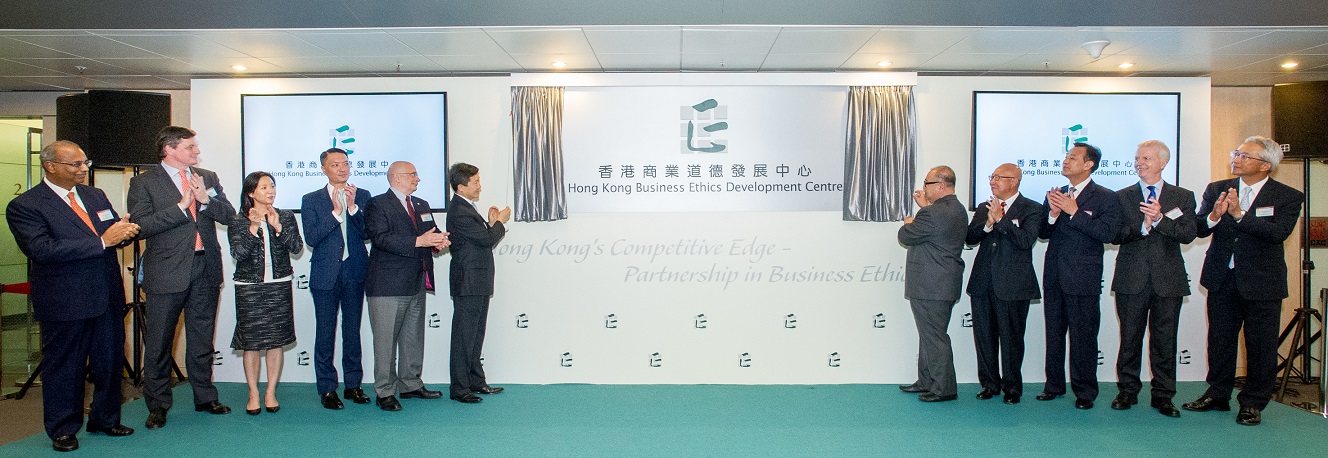
ICAC Commissioner Simon Peh Yun-lu and ten Hong Kong Business Ethics Development Advisory Committee members unveil the plaque of the newly rebranded Hong Kong Business Ethics Development Centre.
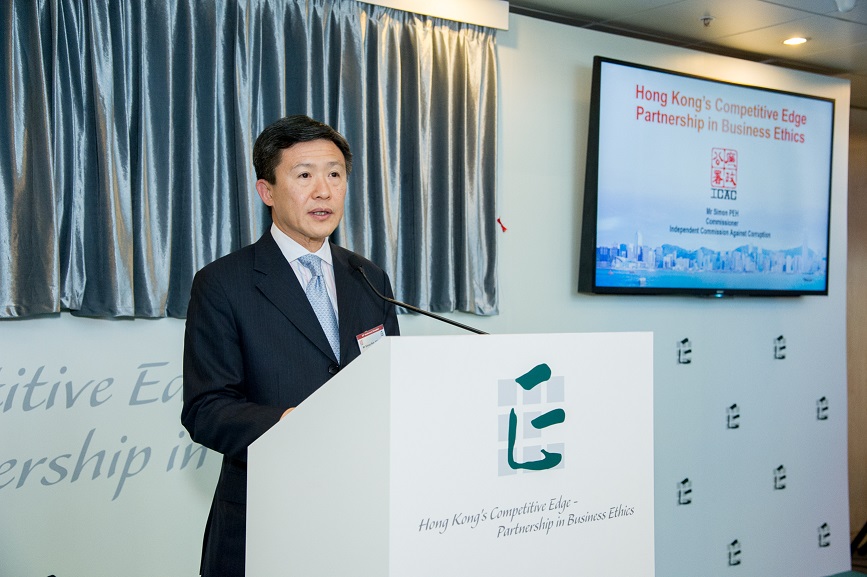
Strengthening business ethics against corruption is the key to maintaining Hong Kong’s competitive edge, says ICAC Commissioner Simon Peh Yun-lu.
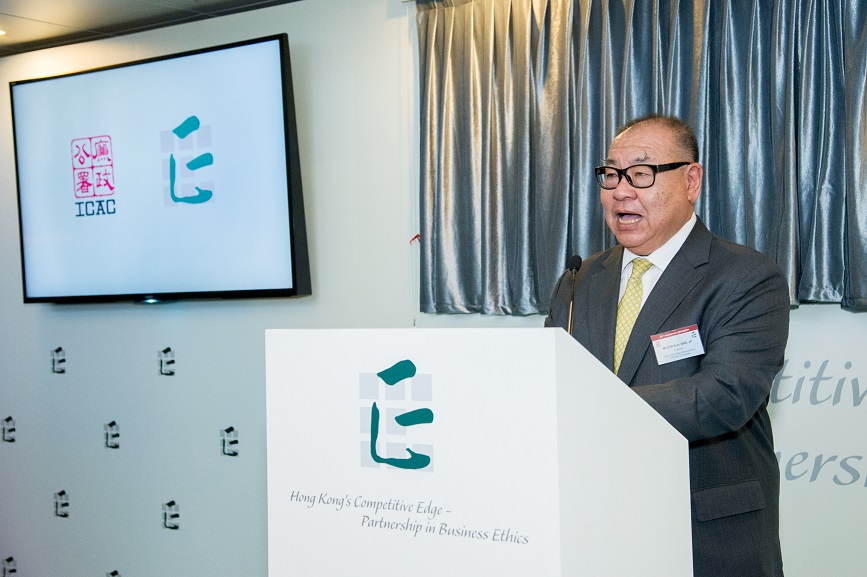
Chairman of HKBEDAC Mr Cliff Sun says that cross sector collaboration was essential in meeting challenges in sustaining a level-playing field in a fast changing world.
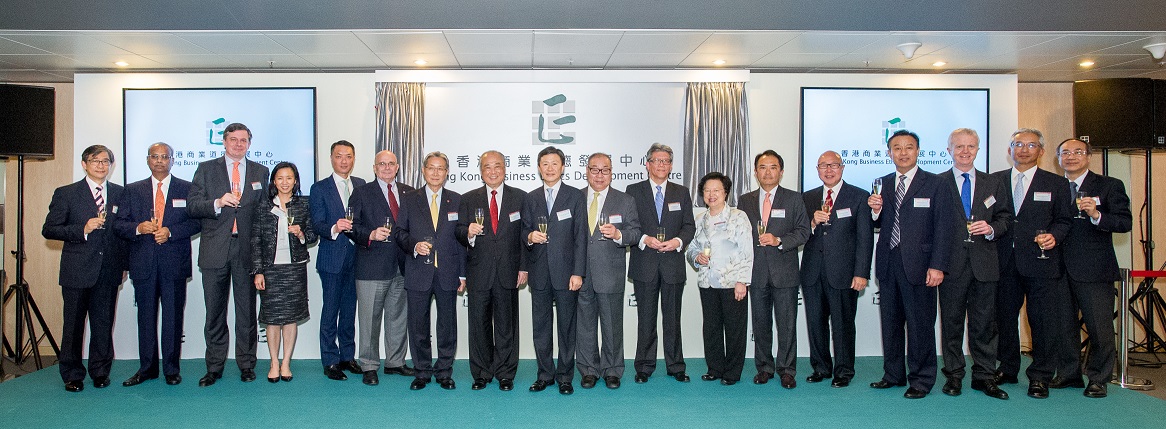
ICAC Commissioner Simon Peh Yun-lu pictured with four ICAC Advisory Committee chairmen, representatives of ten chambers of commerce and three ICAC heads of departments.