
The InTECHgrity Framework
Purpose
Background
Digitalisation is widely recognised as a powerful tool in corruption prevention. Automation reduces reliance on manual processes, data analytics enhances transparency and risk detection, and embedded system controls strengthen governance and oversight. Yet, without intentional design and integrity awareness, digital systems may simply replicate existing vulnerabilities or create new risks.
The InTECHgrity Framework provides step-by-step, actionable guidance and practical examples to help organisations leverage advanced technologies to systematically embed effective corruption-prevention controls into their IT systems by design.
Built on the principle of "Corruption Prevention by System Design", the framework promotes embedding integrity controls into computer systems at the design stage, ensuring they are integrated from the outset.
By adopting this framework, organisations can:
- Systematically embed corruption-prevention controls into digital systems
- Seamlessly integrate controls to enhance risk management without compromising efficiency
- Avoid costly retrofitting of controls at a later stage
Target Users
The InTECHgrity Framework is designed for organisations in both the public sector (including government departments and public bodies) and the private sector, particularly those implementing or managing digital systems.

Senior Management & Decision Makers
To champion corruption-prevention-by-design, set the tone at the top, and ensure digital transformation initiatives align with governance and integrity objectives.
Process Owners
To ensure that business processes and digital workflows incorporate appropriate integrity safeguards and address corruption risks before and during automation.
IT Contractors, System Architects & Developers
To embed integrity controls into system design, configuration, and implementation, translating governance requirements into enforceable technical controls.
Audit, Compliance & Risk Management Professionals
To evaluate digital processes for integrity risks, assess the adequacy of embedded controls, and leverage technology and data analytics to strengthen oversight.
InTECHgrity Framework
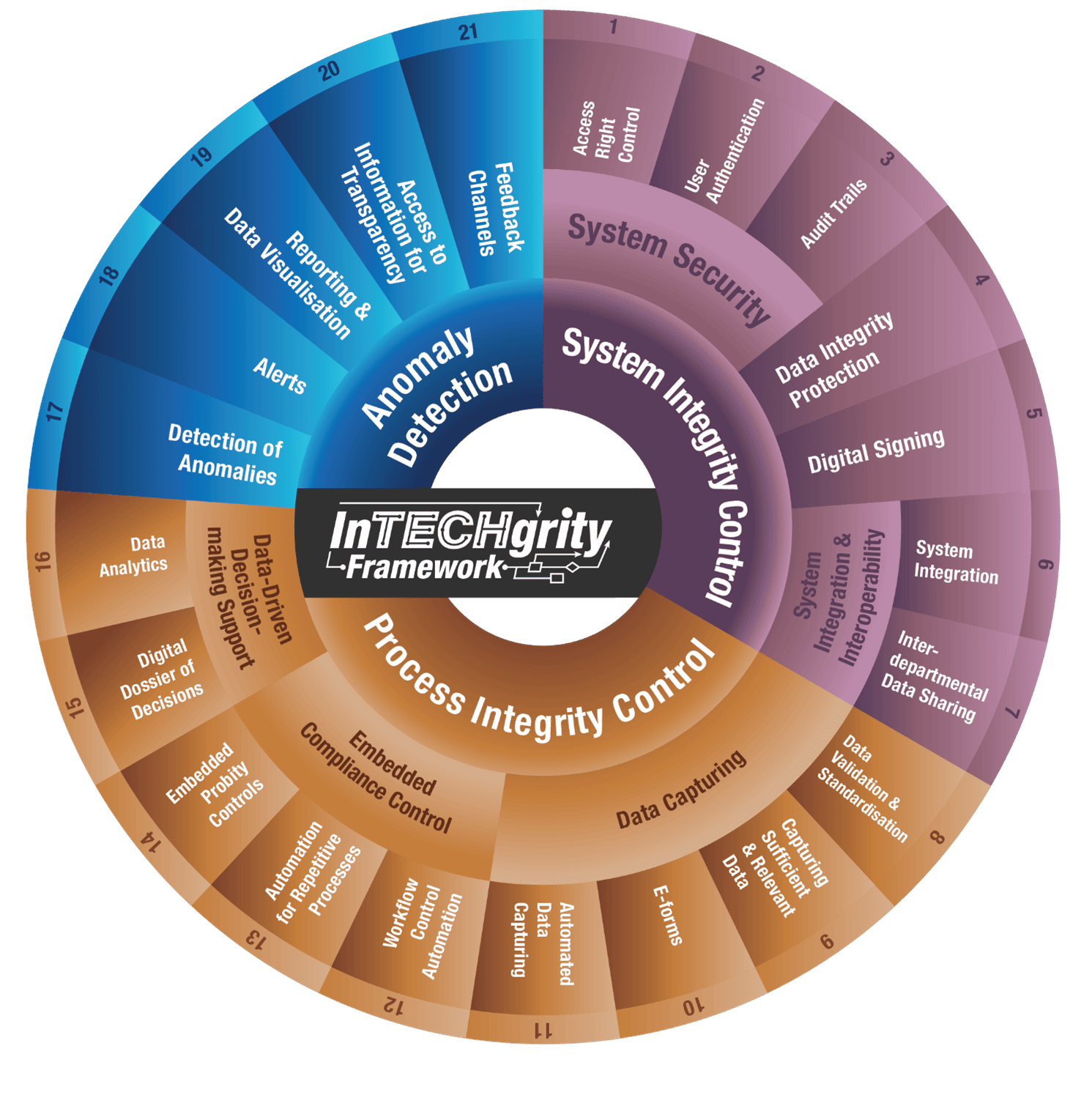
The InTECHgrity Framework sets out 21 essential integrity controls for computer systems to prevent and mitigate corruption risks. These controls are grouped under three overarching control objectives.
System Integrity Controls
Safeguarding the system’s core functions
These controls protect the technical foundation of the system through secure configuration, strong access management, segregation of duties, and tamper-resistant audit trails, ensuring the system cannot be easily manipulated or overridden.
Click the icon below to learn more.
Process Integrity Controls
Embedding integrity into digital workflows
These controls ensure that workflows — from data capture to approval — are system-enforced to prevent manipulation, reduce excessive discretion, and close process loopholes through automation and built-in safeguards.
Click the icon below to learn more.
Anomaly Detection Functions
Enabling early identification of irregularities
These functions leverage analytics, alerts, dashboards, and exception reporting to detect unusual patterns and red flags early, enabling timely intervention and continuous control enhancement.
Click the icon below to learn more.