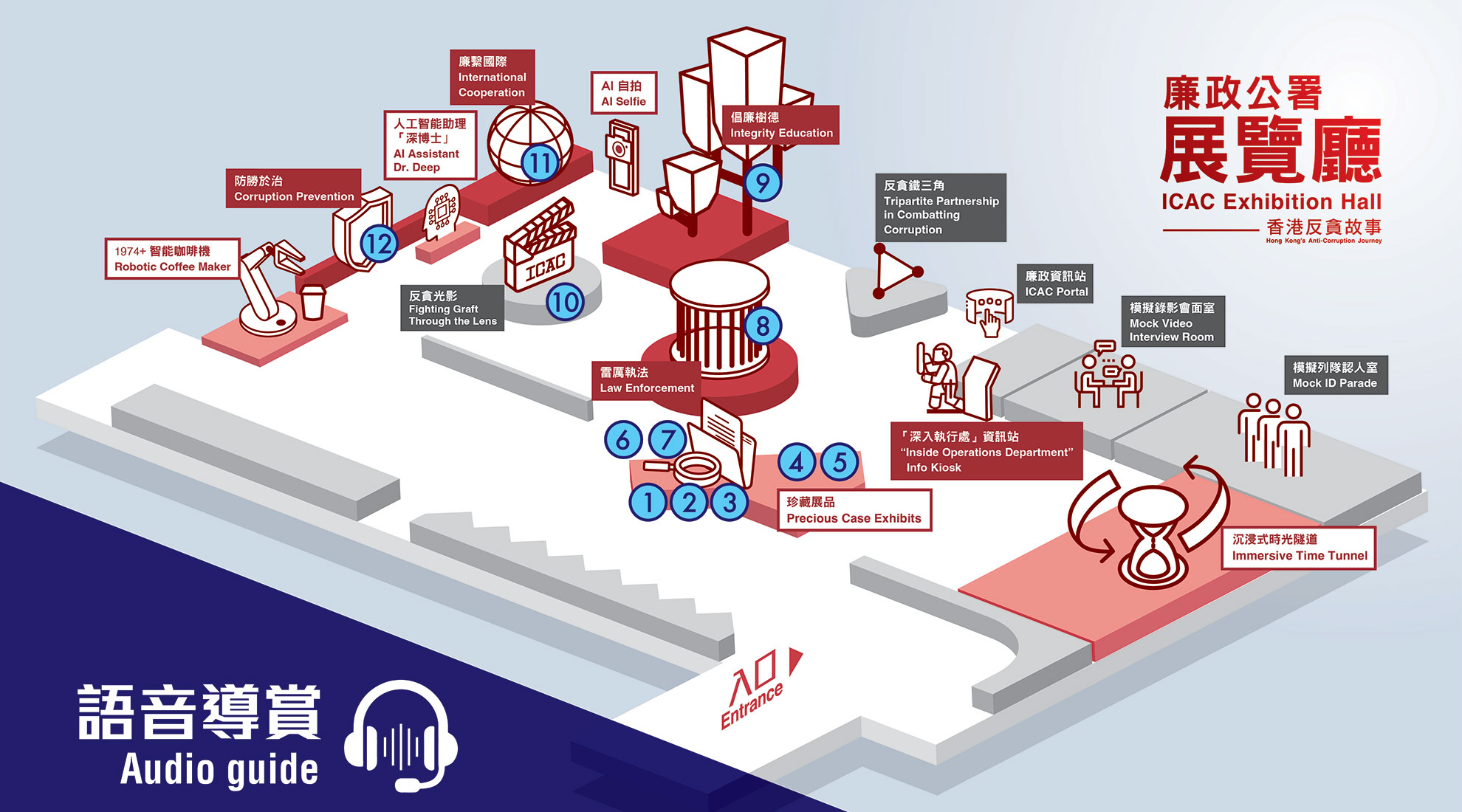
Please bring your own headphones to enjoy the audio guide in the Exhibition Hall.
Quick Jump
Introduction
"ICAC! I am an investigator of the Independent Commission Against Corruption!" This line is familiar to many from dramas about the ICAC, but only a few have actually stepped inside its headquarters. Now, you can visit the ICAC Building not only to enjoy "ICAC Coffee" at the ground-floor Café "1974", but also to explore the Exhibition Hall on the second floor. Equipped with digital and interactive installations alongside a wide variety of exhibits, the Exhibition Hall showcases the ICAC's mission of fighting corruption and promoting integrity, offering an immersive anti-corruption journey for all.
During your visit, you can refer to the online exhibition map. Exhibits with audio guides are marked with numbers. Simply listen directly on the page, or scan the QR codes on site to access the audio guide.
1. Godber Case and Establishment of the ICAC
That is Peter Godber, the man with a gloomy expression on the left side of the exhibition panel. He was the centre of a corruption scandal that shocked Hong Kong in the 1970s and was closely tied to the establishment of the ICAC in 1974.
In the early 1970s, the police uncovered that Godber, then a police chief superintendent, had amassed great wealth through corrupt practices. As a result, an investigation was launched. In 1973, he was required by law to explain the source of his assets. Yet, before the deadline, Godber evaded airport checks with his special airport security permit and fled to the United Kingdom. His escape stunned the public and forced the Government to tackle the problem of deep-rooted corruption. This ultimately led to the decision to establish the ICAC, adopting a three-pronged approach of enforcement, prevention, and education to fight corruption.
The new ICAC swiftly took over the Godber Case. After months of effort, Godber was extradited from the United Kingdom to Hong Kong to stand trial in early 1975. He was later convicted and imprisoned. Bringing Godber to justice not only demonstrated the ICAC's determination, but also marked a new chapter in Hong Kong's fight against corruption.
2. Authentic Godber's Ledger
The "Godber's Ledger" in the display case is a vital piece of history and evidence from the Godber Case dating back over fifty years. During the investigation, three "bribe money ledgers" were seized from Godber. Spanning more than 200 pages, these ledgers meticulously documented bribery transactions across Hong Kong Island, Kowloon and the New Territories. In total, they involved over 3,000 units offering bribes, which were tied to activities such as illegal bookmaking, nightclubs, brothels, mahjong schools and opium dens. You may touch the screen on the right to flip through the pages of the "Godber's Ledger".
3. How Corrupt Was Godber?
Godber served in the police force for twenty-two years, earning a total net salary of less than 770,000 Hong Kong dollars. Yet, his actual wealth exceeded 4.3 million dollars - nearly six times his official earnings. According to evidence given by a tainted witness, Godber received over 30,000 dollars in bribes every month, an amount greater than the salary of any government official at the time.
4. Yau Ma Tei Wholesale Fruit Market: Breeding Ground of Crime
The model before you shows the Yau Ma Tei Wholesale Fruit Market as it appeared in the 1970s. This was a key battleground where the ICAC, in its early years, dismantled syndicated corruption within government departments.
Back in the 1970s, the Fruit Market was a bustling hub crowded with stalls and people. Its convenient location and the protection of corrupt law enforcement officers allowed it to become a hotbed of vice, gambling, and drug activities.
Starting in 1976, the ICAC launched massive anti-corruption operations targeting law enforcement officers who sheltered drug trafficking there. The crackdown led to the arrest of over 200 people, mostly law enforcement personnel, and the prosecution of 26 civil servants. To explore this milestone case further, you can examine the historical photographs, maps and the bribery ledger displayed in the showcase.
In the years that followed, crime at the Fruit Market gradually subsided. Today, the Fruit Market is designated as a Grade II historic building. Many fruit wholesalers still operate there. Some even runs retail businesses alongside. It is well worth a visit in person!
5. Partial Amnesty
The ICAC's fight against corruption has never been an easy journey. In its early days, the ICAC's unyielding approach sent shockwaves through government departments, and this strained relations with some civil servants. In 1977, following the Yau Ma Tei Wholesale Fruit Market Case, the ICAC arrested over one hundred police officers. This sparked resentment within the police force. A mass rally was organised to petition the Commissioner of Police. Dozens of police officers made for the ICAC Operations Department headquarters, leading to a brief confrontation. It was only after police intervention to clear the scene that order was finally restored.
To prevent the crisis from spiralling out of control, Governor MacLehose announced a "partial amnesty", directing the ICAC not to act on the corruption offences committed before 1977, save for certain specified exceptions. Although this meant the ICAC had to terminate some investigations, subsequent developments proved that its determination to fight corruption never wavered. The society continued to stand firmly behind the Commission's mission to combat corruption and promote integrity.
Today, Hong Kong has a highly efficient and clean civil service. Government departments also work closely with the ICAC to jointly combat and prevent corruption.
6. "Chinese Detective Sergeants": Who Were They?
Back in the 1950s through 70s, Hong Kong was divided into three main police regions: Hong Kong Island, Kowloon and the New Territories. Each region had its own chief detective sergeant, and under him were detective sergeants responsible for criminal investigations. As many high ranking expatriate officers did not understand Chinese, they had to rely on their Chinese detective sergeants when carrying out investigations. As a result, these Chinese detective sergeants, despite their lowly rank, wielded immense influence - a power that enabled them to exploit their positions and solicit massive bribes.
The tide turned with the birth of the ICAC, which launched investigations into these detective sergeants. In a prominent case, a detective sergeant was convicted and imprisoned for possessing pecuniary resources which were disproportionate to his official emoluments. His assets, amounting to 16 million Hong Kong dollars, were confiscated. By contrast, his total salary during his police career was only about 228,000 dollars - a staggering seventy-fold difference.
The Mystery of a Police Detective Sergeant's Wealth(Open in new tab)
7. "Anti-Corruption" as Cultural Symbol in Hong Kong Cinema
The dark old days of rampant corruption in Hong Kong gradually came to an end with the establishment of the ICAC. This journey has provided an endless source of inspiration for film and television productions. For instance, several Hong Kong films centred on the corrupt dealings of the "Chinese detective sergeants", portraying the timeless battle between good and evil. By weaving real historical backdrops with gripping fictional elements, these filmmakers crafted intricate plots that captivated audiences. Not only did these films shape a distinctive "anti corruption" cultural symbol in Hong Kong, they also reflected society's memory of how the city emerged from the shadow of corruption.
8. The Corruption Fighters: On the Frontline of Fairness
At the core of the ICAC's formidable enforcement power stand its investigators. Facing corruption head-on – across public and private sectors, in cases large and small, and against individuals of any background – they pursue investigations strictly in accordance with the law, safeguarding fairness and justice in Hong Kong. Standing before you is a large-scale installation "Caging Corruption". This striking piece embodies the city's unyielding spirit and its absolute zero-tolerance towards corruption.
The five officers on the screen are real ICAC investigating officers. You may tap the screen to hear them share insights into different forms of corruption and the challenges they faced during investigations. You can also view case introductions that reconstruct the details of these operations.
9. Integrity Education: Embedding Culture of Integrity into Society's DNA
The adorable cartoon character greeting you right now is "Little Coffee Bean". As one of the ICAC's beloved integrity ambassadors, he frequently stars in ICAC's children picture books, animations and community activities. His mission is to spread positive values, such as honesty and rule-abiding, to the younger generation.
Education is essential to the effective fight against corruption. Beyond raising public awareness of anti-corruption laws and the evils of corruption, the ICAC plants the seeds of integrity across society, embedding a culture of integrity into the DNA of Hong Kong.
Through the touch screen, you can explore how the ICAC tailors its educational approach to different target audiences, weaving anti-corruption messages seamlessly through both online campaigns and offline initiatives.
10. ICAC Drama: Hong Kong's Longest-Running Television Story
The precious video clips before you do more than just document the ICAC's anti-corruption journey, but also capture the remarkable transformation of Hong Kong society.
Since 1976, the ICAC has embraced television drama as a powerful tool for publicity and education. From the ground-breaking early series "Silent Revolution", to "ICAC Vanguard", and more recently "ICAC Investigators", the ICAC has produced more than a hundred episodes. This incredible run makes it one of the longest-running television franchises in Hong Kong.
At the outset, these dramas carried the mission of reshaping social values: reminding the public that corruption was no longer a way of life, and that it must be reported when encountered. Over the decades, these gripping stories - all adapted from real cases, have helped audiences understand the harmful nature of graft, while offering an inside look at the intense challenges faced by investigators on the front lines.
Today, the entire collection is available on the ICAC website for free viewing – a treasure trove not to be missed!
11. International Collaboration: Building Global Anti-Graft Barrier
In our interconnected world, corruption knows no boundaries. The ICAC actively joins forces with Mainland and overseas partners to combat corruption, share expertise, and strengthen the global anti-corruption frontline.
The ICAC operates the Hong Kong International Academy Against Corruption. It serves as a training and research platform for anti-corruption professionals worldwide, telling Hong Kong's story of integrity and rule of law to the world. At the same time, the ICAC Commissioner now chairs the International Association of Anti-Corruption Authorities (IAACA), maintaining close ties with member agencies across the globe and promoting the effective implementation of the United Nations Convention against Corruption.
Drawing on the ICAC's half-century of anti-corruption expertise, the Academy's professional training, and the IAACA's vast global network, a powerful tripartite partnership has been forged. This strategy places Hong Kong at the forefront of global anti-corruption development. To explore the global footprint of this cooperation, simply press the buttons on the screen before you.
12. Corruption Prevention: Reducing Integrity Risks at Source
To truly eradicate corruption, we must tackle the problem at its roots. This is where the ICAC's corruption prevention experts step in, addressing the issue from a systemic perspective.
These specialists study the workflows of government departments and public bodies, pinpointing corruption loopholes and recommending improvements. For instance, the ICAC helps design clear and transparent mechanisms in critical areas, such as law enforcement, procurement, and licensing, in order to ensure power is not abused.
Beyond the public sector, the ICAC also provides private organisations with professional advice to build sound internal monitoring systems, ensuring corruption cannot infiltrate.
You may view on the screen how this ICAC's proactive approach helps various sectors fortify their defences, living out the principle that "prevention is better than cure".